


You've been using AI for a while
You’re building better prompts. The output speeds up. You've developed a rhythm: draft it in Claude, clean it, ship it.
Your output is improving incrementally. Each version looks better than the last one. You're comparing this week's draft to last month's draft and calling it progress.
But you're not comparing it to an objective editorial standard.
AI found your standard and leveled to it: at volume, with confidence. If you've never developed a sharp instinct for what quality looks like in your work, the tool has no way to know the difference. It'll produce at your level, consistently, and that consistency feels like quality. This is a placebo effect of AI marketing output.
Your Claude-drafted client emails that feel synthetic. You publish undifferentiated product listings. Your marketing VA delivers social posts that are completely forgettable. The output is faster than it used to be. It's more consistent. The output is incrementally better.
You need to assess your output to diagnose where quality falls short or strays from the message or voice. There are two tools for this: a mental model for how best to use AI and an editorial quality bar.
Without both, better prompts just deliver mediocrity at scale.
AI Prompting for Better Output
At the high-end, LLMs are more than autocomplete on steroids, but they need help with editorial discernment.
Claude, or any AI tool you use, is a capable first- and second-draft machine. But it has no judgment, no context beyond what you give it, and no quality control beyond what you enforce.
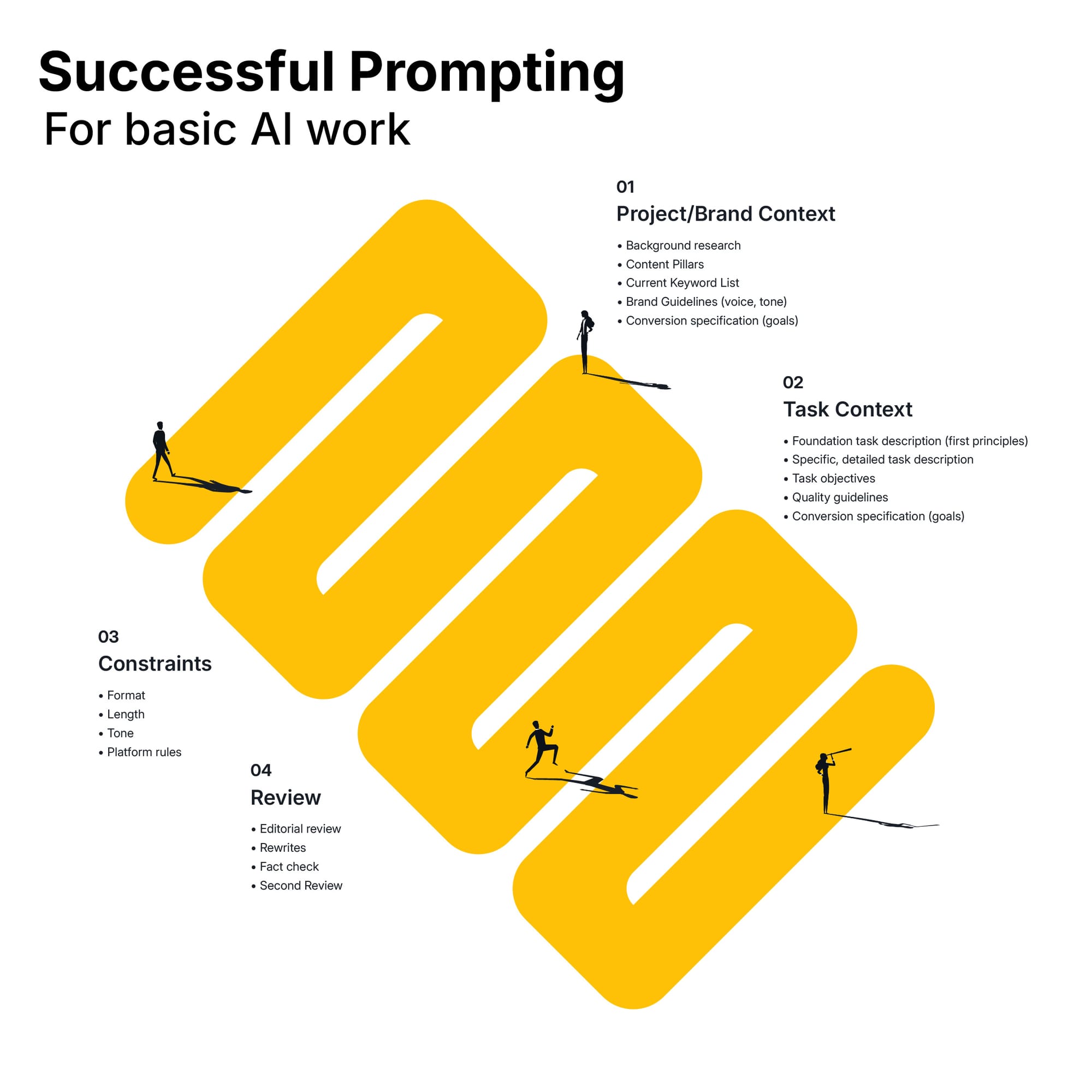
Maybe you’ve bought the hype, given AI a task, and expect a finished deliverable. What you get instead is raw material formatted like a finished deliverable: clean sentences, correct structure, confident tone. Four things you need for a usable draft:
- Project/Brand Context
- Background research
- Content Pillars
- Current Keyword List
- Brand Guidelines (voice, tone)
- Conversion specification (goals)
- Task Context
- Foundation task description (first principles)
- Specific, detailed task description
- Task objectives
- Quality guidelines
- Constraints
- Format
- Length
- Tone
- Platform rules
- Review
- Editorial review
- Rewrites
- Fact check
- Second Review
Those inputs don’t supply judgment. If you've never developed a sharp sense of what your best work looks like, there's nothing for the tool to amplify. Building a profile of your best work (for a specific brand) begins with developing your brand context.
Mindset trumps prompt skills: AI doesn’t produce finished work, but it can eliminate the first through third drafts. Call it the 60/40 rule — Claude executes 60%, you bring 40%.
Freelancers, virtual assistants, and in-house marketers who get real value from AI invest time in developing a framework for excellence and monitor the data relentlessly to improve performance. If your stuck getting incrementally better at mediocre output, you need upgrade your quality standard.
The Adoption Gap
None of this is about AI replacing you. It's about who's using it well while you're still figuring out where the edges are.
There are three stages people move through, and almost everyone believes they're one stage ahead of where they are today.
- Stage 1 — Dabbling
- Ad hoc prompt writing
- Extensive revision process
- AI fingerprints on content
- Stage 2 — Selective use.
- Usage for specific task usage
- Somewhat consistent activity
- Limited output consistency
- Some time saved
- Stage 3 — Systematic
- SOPs for brand context, project context, and prompt design
- Context by brand, project, and task
- Quality, Consistent output
- Higher volume/faster output
- Output improvement baked into process
Most people who'd describe themselves as Stage 2 are still at Stage 1. A habit feels like a system from the inside. The difference only shows up when someone asks you to explain your process; you realize you have a pattern you've repeated often enough that it feels deliberate.
Marketers who reach Stage 3 build robust, refinable workflows. Every week they run a documented process and refine it. In twelve months, that's significant improvement.
The Tool Categories
Here is our particular tech stack. We combine open source tools with our LLM of choice, Claude, and more conventional video tools of Adobe’s suite.
- Foundation AI — Claude & Qwen3 (open source)
- Ideation
- Deep research
- Brand copy - email, blogs, presentations, posts
- Learning
- SOP’s
- Task Automation - Claude & Z.ai
- Posting/reposting
- Content variation for platforms
- Social listening
- Reporting
- Visual Production — Adobe Suite/Express, Z.ai, Wan
- Social graphics
- Infographics
- Ad creative
- Post headers
- Video posts
- Presentations
- Meeting intelligence — Granola (Mac)
- AI-enhanced meeting notes
- Structured summaries
- Action items
Context for Content
Most AI tools now remember things between sessions. Claude has Projects, where you can set up a persistent space with files, instructions, and context that carry across every conversation instead of disappearing the moment you close the tab.
For content work specifically, our standard project context includes:
- Background research
- Market overview
- Adjacent markets
- Competitive survey
- Ideal customer profile(s)
- ICP online activity profile
- Brand overview
- Brand summary
- Mission, vision, values
- Objectives by quarter for 6 quarters
- Brand strategy
- Content pillars
- Content strategy
- 3-5 themes
- Weighted posting percentages
- Keywords
- For incorporation across media
- Updated quarterly
- Brand Voice
- The one thing: content objective
- Voice and tone
- Examples/counter-examples with rationale
- Counter AI prescription
Build these using the best model you can afford since these will govern your content going forward. Load these into your content Project, and every piece of work you do inside it automatically carries that context. That's what separates a virtual assistant running Stage 3 from someone re-explaining their brand voice in every new chat.
This is the SOP apporach from earlier in this post, applied to anything you produce with AI: a documented, reusable version of the brief you'd give a new hire — written once and refined over time..
Test Your Content
If you use an AI platform regularly, it is probably improving, especially if you read your reports closely to understand which content performs best.
Pull up the last three things you made with AI. A client email, a product listing, a caption, whatever you've got. Read them the way a demanding client would read them. Not "is this acceptable," but "is this good."
- If the answer is yes, you already have a standard. Everything in this series from here is about building a system around it, built for speed and scale.
- If you're not sure, that's the answer too. And it's not a bad place to start from. Build your output standards, and then the tools and the workflows follow.
Build it backward, and you're making slop.